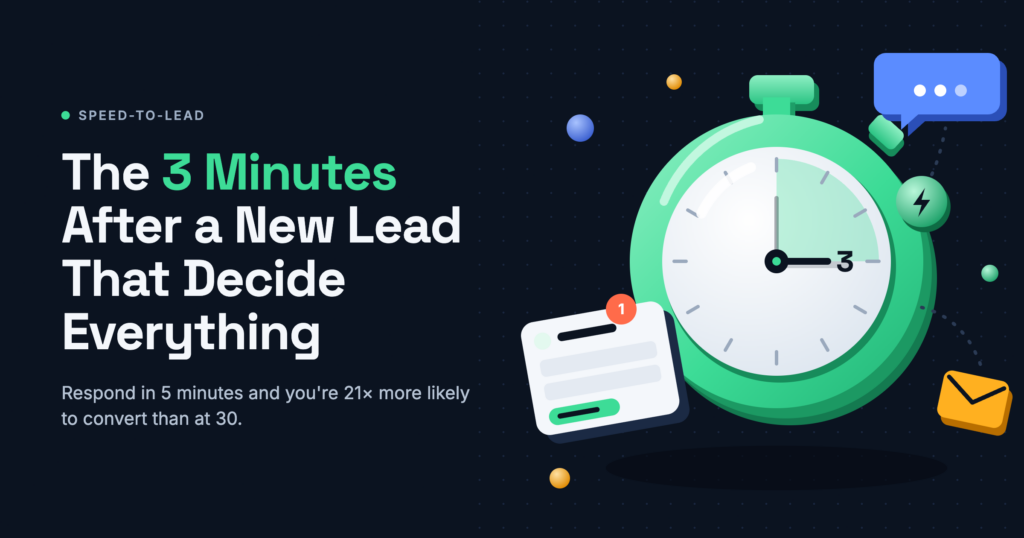
A lead fills out your form. The clock starts. Inside of three minutes, that lead is either engaged or already moving on.
Most businesses don’t respond in three minutes. Most businesses don’t respond in three hours. And by the time they do, the lead has filled out two more forms somewhere else.
Speed-to-lead isn’t a new concept. The data has been clear for over a decade: the faster you respond to a new inquiry, the higher the conversion rate. A response within five minutes is 21 times more likely to convert than a response at 30 minutes.
Everyone knows this. Almost nobody does it. Because doing it manually means being available, every hour of every day, to notice a new submission and respond with something relevant. That’s not a business strategy. That’s a lifestyle sentence.
The alternative isn’t ignoring speed. It’s building the speed into the system so it happens without you being present for it. The lead submits a form, the system responds. Not with a generic “we got your message” email – with an actual response that acknowledges what they asked and moves the conversation forward.
What matters in those first three minutes isn’t perfection. It’s presence. The lead wants to know someone is on the other end. They want to know their inquiry didn’t vanish into a queue.
The difference between platforms that deliver this and platforms that don’t comes down to one thing: does the system treat a new lead as a trigger or as a notification? A notification tells you something happened and waits for you to act. A trigger starts a sequence the moment the event occurs – follow-up fires, the CRM logs context, and the lead gets a response that feels human even when no human was involved.
That’s what the 15-Point Follow-Up inside Apex Suite AI is designed around. It doesn’t wait for you to notice. It owns the first touchpoint, the second, the third – across channels, across time intervals – until you’re ready to step in with a live conversation that already has context behind it.
The lead doesn’t know the difference. They just know someone responded. Fast.
You can’t be available every minute of every day. Your system can. And the businesses that figure that out first are the ones that stop losing leads to the three-minute window.